We are pleased to introduce a new ARCAD INC. safety supplies store online at http://store.arcadvisor.com. ARCAD is now providing high-quality, dependable products you can trust to keep employees and work sites safe. We offer standard materials and sizes, and an easy to use online shopping experience. Search by keyword, part number or category to find exactly what you need to help keep your workers safe and your workplace compliant with safety regulations. Shop our store, or simply contact us at (647) 693-7715 or sales@arcadvisor.com. We are happy helping you meeting your needs.
All safety signs come in three size options (6 x 4, 9 x 6 and 12 x 8 inches) and are UV, water, and smear resistant. All are printed with UV-stable ink and are suitable for indoor or outdoor use at service temperatures from -40 to +180 F. Substrate choices are:
- Flexible vinyl 4mil self-adhesive "peel & stick" label stock
- Semi-flexible laminated vinyl self-adhesive label
- Rigid aluminum 3mm thick composite panel
Can’t find what you need? It is easy to design and order custom stickers and labels. We will manufacture to your specifications at our manufacturing facility.
ARCAD INC. is also offering many options of custom printed arc flash labels. Send us your data in Excel spreadsheet or plain text format. We will create a free sample label accommodating your special requirements and send it to you for your approval along with job quotation.
Tuesday, August 18, 2015


Monday, July 27, 2015
Issue #28 - ARCAD website redesigned and revamped
After much hard work, we are pleased to introduce a
completely redesigned ARCAD website at www.arcadvisor.com.
Please take a few moments to navigate through the
updated website. We hope you enjoy the new design and
you'll find time to look through the many pages of
information waiting for you behind the new home page.
Please feel free to let us know about any suggestions
you might have or additional material you would like to
see on the website.
We have also recently released new Short Circuit Analytic (SCA) mobile app. The app takes into consideration all of the key electrical parameters of power distribution system including power supply, cables, transformers, motors, generators and performs available short circuit 3-phase and phase to phase fault current calculations in three-phase radial electric power systems. Visit the SCA mobile product page online at http://www.arcadvisor.com/
Did you know that most fabrics recommended for protection against electric arc fires will burn vigorously when exposed to a sufficiently large and sustained exposure fire? NFPA 70E allows flammable clothing with a fabric weight at least 4.5 oz/yd2 to be worn when working on tasks stated low risk. Stating a task as low risk and allowing the use of apparel fabrics may lead to severe injuries and fatalities from clothing ignitions in arc flash incidents. A method predicting the behavior of the fabrics during convective and radiant heating has been developed, and an article describing the method was recently published in the International Association of Electrical Inspectors (IAEI) magazine. Please follow the link at http://www.arcadvisor.com/faq/
We have also recently released new Short Circuit Analytic (SCA) mobile app. The app takes into consideration all of the key electrical parameters of power distribution system including power supply, cables, transformers, motors, generators and performs available short circuit 3-phase and phase to phase fault current calculations in three-phase radial electric power systems. Visit the SCA mobile product page online at http://www.arcadvisor.com/
Did you know that most fabrics recommended for protection against electric arc fires will burn vigorously when exposed to a sufficiently large and sustained exposure fire? NFPA 70E allows flammable clothing with a fabric weight at least 4.5 oz/yd2 to be worn when working on tasks stated low risk. Stating a task as low risk and allowing the use of apparel fabrics may lead to severe injuries and fatalities from clothing ignitions in arc flash incidents. A method predicting the behavior of the fabrics during convective and radiant heating has been developed, and an article describing the method was recently published in the International Association of Electrical Inspectors (IAEI) magazine. Please follow the link at http://www.arcadvisor.com/faq/
Friday, June 12, 2015
Product Release - Short Circuit Analytic Mobile V1.0 for Androids
|
||||||||||||||||


Monday, April 6, 2015
Issue #27 - Ignition and Melting Characteristics of Protective Clothing
Wishing you a Happy Easter! I hope some time out for rest and
relaxation with your loved ones puts a spring in your step and gives
you a chance to celebrate life and all its blessings. Peace, love,
joy and yummy Easter eggs to you!
Here at ARCAD INC., we would also like to express to you our sincere appreciation for your loyalty and take this opportunity to update you on arc flash news and ARCAD INC. solutions addressing the matter.
HOW TO EVALUATE THRESHOLD INCIDENT ENERGY FOR IGNITION OR MELTING OF PROTECTIVE CLOTHING
In many cases, if exposed to a sufficiently large and sustained exposure fire, the fire-retardant (FR) fabrics will burn vigorously. Fabric's time to ignition or melting versus heat flux data can be used for determining the textile TDU value. For example, Figure 1 shows that it takes approximately 5cal/cm2/sec heat flux for igniting denim textile listed in Table 1 within 3 seconds time interval. The TDU value for the denim fabric can be calculated by substituting the values for heat flux and time to ignition into Equation 4, and it is roughly equal to 3800(kW/m2)4/3 * sec. Behavior of the fabrics other than those listed in Table 1 during convective and radiant heating can be predicted using a simple test that can be quite easily reproduced in the field.
[ Read the whole article online at http://www.arcadvisor.com/faq/
"The 2015 edition of nfpa 70e no longer has a PPE Category 0, however my software still calculates Level 0. What am I missing?"
Indeed, the AFA V5.0 software does not show anywhere the term "PPE Category" or "Hazard Risk Category" (HRC). The program displays term "Level". The new NFPA 70E 2015 does not prohibit using the term "Level". As long as you don't call it "PPE Category" there should be nothing preventing you from doing so. Remember that not that long ago people were told not to mix HRC with incident energy. So they began to call it 1, 2, 3 and 4 PPE categories to get away from the term HRC. This time around the NFPA 70E claimed ownership for the term "PPE category" that people moved to, and say you can't use that term with incident energy. Also, the NFPA Handbook shows a sample label with fields to be filled in for "Available Incident Energy" and "Level of PPE" while just half a page earlier states that "available incident energy" cannot be included with the "PPE category" in table 130.7(C)15(A)(b). It makes sense since the "Level of PPE" and "PPE Category" are technically two different terms.
Clicking on Settings menu, selecting Incident Energy at AFB and switching to Evaluated option will also prevent the Level 0 displayed on arc flash labels created using the AFA V5.0 program. Also, you can edit default site-specific PPE by clicking on Settings menu, selecting Site Specific PPE and making required changes.
MODELLING HRC FUSES FOR ARC FLASH ANALYSIS
IEEE 1584 Guide for Performing Arc Flash Calculations has established practice when modelling HRC fuses for arc flash analysis. The IEEE 1584 4.6 Step 5 reads "For fuses, the manufacturer's time-current curves may include both melting and clearing time. If so, use the clearing time. If they show only the average melt time, add to that time 15%, up to 0.03 seconds, and 10% above 0.03 seconds to determine total clearing time. If the arcing fault current is above the total clearing time at the bottom of the curve (0.01 seconds), use 0.01 seconds for the time". The opening time tolerances differ between fuse designs and the percentage of the overload relative to the amp rating. Incrementing the time according to IEEE 1584 guidelines should effectively compensate for the margin of error in published time-current curves in most cases.
[ Read more at http://www.arcflashforum.com/
MORE SOFTWARE PROGRAMS AND SERVICES BY ARCAD INC
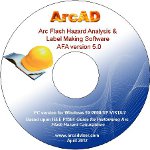
Arc Flash Assessment and Labeling Software
Arc Flash Mobile Apps
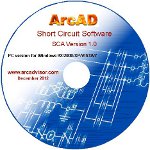
Short Circuit Calculation Software
Label Printing Services.
Did you know that we are now on Facebook? We are updating regularly so we invite you to take a look and stay up-to-date by liking or following our Facebook page. Choose to "Friend" or "Like" us and be instantly notified when we release new product or service or post special deals and announcements.
Here at ARCAD INC., we would also like to express to you our sincere appreciation for your loyalty and take this opportunity to update you on arc flash news and ARCAD INC. solutions addressing the matter.
HOW TO EVALUATE THRESHOLD INCIDENT ENERGY FOR IGNITION OR MELTING OF PROTECTIVE CLOTHING
In many cases, if exposed to a sufficiently large and sustained exposure fire, the fire-retardant (FR) fabrics will burn vigorously. Fabric's time to ignition or melting versus heat flux data can be used for determining the textile TDU value. For example, Figure 1 shows that it takes approximately 5cal/cm2/sec heat flux for igniting denim textile listed in Table 1 within 3 seconds time interval. The TDU value for the denim fabric can be calculated by substituting the values for heat flux and time to ignition into Equation 4, and it is roughly equal to 3800(kW/m2)4/3 * sec. Behavior of the fabrics other than those listed in Table 1 during convective and radiant heating can be predicted using a simple test that can be quite easily reproduced in the field.
[ Read the whole article online at http://www.arcadvisor.com/faq/
"The 2015 edition of nfpa 70e no longer has a PPE Category 0, however my software still calculates Level 0. What am I missing?"
Indeed, the AFA V5.0 software does not show anywhere the term "PPE Category" or "Hazard Risk Category" (HRC). The program displays term "Level". The new NFPA 70E 2015 does not prohibit using the term "Level". As long as you don't call it "PPE Category" there should be nothing preventing you from doing so. Remember that not that long ago people were told not to mix HRC with incident energy. So they began to call it 1, 2, 3 and 4 PPE categories to get away from the term HRC. This time around the NFPA 70E claimed ownership for the term "PPE category" that people moved to, and say you can't use that term with incident energy. Also, the NFPA Handbook shows a sample label with fields to be filled in for "Available Incident Energy" and "Level of PPE" while just half a page earlier states that "available incident energy" cannot be included with the "PPE category" in table 130.7(C)15(A)(b). It makes sense since the "Level of PPE" and "PPE Category" are technically two different terms.
Clicking on Settings menu, selecting Incident Energy at AFB and switching to Evaluated option will also prevent the Level 0 displayed on arc flash labels created using the AFA V5.0 program. Also, you can edit default site-specific PPE by clicking on Settings menu, selecting Site Specific PPE and making required changes.
MODELLING HRC FUSES FOR ARC FLASH ANALYSIS
IEEE 1584 Guide for Performing Arc Flash Calculations has established practice when modelling HRC fuses for arc flash analysis. The IEEE 1584 4.6 Step 5 reads "For fuses, the manufacturer's time-current curves may include both melting and clearing time. If so, use the clearing time. If they show only the average melt time, add to that time 15%, up to 0.03 seconds, and 10% above 0.03 seconds to determine total clearing time. If the arcing fault current is above the total clearing time at the bottom of the curve (0.01 seconds), use 0.01 seconds for the time". The opening time tolerances differ between fuse designs and the percentage of the overload relative to the amp rating. Incrementing the time according to IEEE 1584 guidelines should effectively compensate for the margin of error in published time-current curves in most cases.
[ Read more at http://www.arcflashforum.com/
MORE SOFTWARE PROGRAMS AND SERVICES BY ARCAD INC
Arc Flash Assessment and Labeling Software
Arc Flash Mobile Apps
Short Circuit Calculation Software
Label Printing Services.
Did you know that we are now on Facebook? We are updating regularly so we invite you to take a look and stay up-to-date by liking or following our Facebook page. Choose to "Friend" or "Like" us and be instantly notified when we release new product or service or post special deals and announcements.
Tuesday, March 17, 2015
Issue #26 - Behavior of Apparel Fabrics during Convective and Radiant Heating
This week is March Break in Canada. Springtime around the world is traditionally observed as a time of renewal. we hope you have an opportunity to engage in some needed spring cleaning such as catching up on some long-delayed project or chore at work or at home, or simply taking a few moments to take stock of your goals. However you plan to spend spring break, we wish you an enjoyable time and an opportunity to focus on yourself, family and friends. We would also like to take this opportunity to update you on arc flash news and ARCAD INC. solutions addressing the matter.
BEHAVIOR OF APPAREL FABRICS DURING CONVECTIVE AND RADIANT HEATING
Personal protective equipment (PPE) recommended for arc flash is not always designed for arc flash exposure. The purpose of this paper and accompanying online calculator is to warn of the dangers posed by using the improper materials in arc flash exposures until standards have caught up on this issue. NFPA 70E allows flammable clothing with a fabric weight at least 4.5 oz/yd^2 ( > 0.16kg/m^2) to be worn when working on tasks stated low risk. Stating a task as low risk and allowing the use of apparel fabrics may lead to severe injuries and fatalities from clothing ignitions in arc flash incidents. The NFPA 70E based arc flash analysis fails to consider the variable nature of onset to second degree burn energy on bare skin. Also, there seem to be issues in NFPA 70E when the standard calculation procedure for determining arc flash boundaries allowing flammable clothing to be worn in situations that could result in ignition of the clothing.
[ Read more ]
CUSTOM LABEL GENERATION AND PRINTING SERVICES
ARCAD INC. offers many options of custom printed arc flash labels. Our vinyl labels are 100% waterproof and are suitable for use on equipment that will be subjected to wet or humid environments. We use UV resistant paints that withstand the heavy wear and tear ordinarily inflicted by the Sun. Send us your data and we will create a free sample label accommodating your special requirements and send it to you for your approval along with job quotations.
Tuesday, February 10, 2015
Issue #25 - Fuse equations for arc flash analysis, changes to safety standards and referral program.
These are some of the latest topics on various aspects of arc flash
you may find interesting:
IEEE 1584 FUSE EQUATIONS
IEEE 1584-2002 provides formulae for calculating arc-flash energies for use with current-limiting Class L and Class RK1 fuses. What is the manufacturer of the fuses used to develop the formulas in IEEE 1584? Do the formulas apply for 440V 50Hz? Check the link below for answers to these and more fuse related questions:
http://www.arcflashforum.com/
MOTOR CONTRIBUTION
How to quantify the time that should be entered for the duration of motor contribution into an arcing fault?
http://www.arcflashforum.com/
NEW GRAPHICS PER THE 2015 NFPA 70E
In the past, the images that include the prohibited approach boundary were used for arc flash labeling. Since the NFPA has discontinued use of the prohibited approach boundary definition, it is recommended to bring arc flash hazard labels up to date with the terminology in the standard. Check the link below for an example of image with only the limited and restricted approach boundaries along with the arc flash boundary shown and accompanying discussion:
http://www.arcflashforum.com/
2015 NFPA 70E CHANGES
The new 2015 Edition of NFPA 70E has been recently released. The following is an article listing the major changes for the 2015 edition. It was originally published in the May 2014 issue of Electrical Contractor Magazine and is provided here as a resource for your use:
http://arcflashforum.com/
2015 CSA Z462 CHANGES
CSA Z462-15 has just been published and is now available on the CSA On-line Store. The following is an overview of the major revisions to the 2015 edition:
http://www.arcadvisor.com/faq/
ARCAD's arc flash calculation software program has been updated in order to conform to the new NFPA 70E and CSA Z462 standards. The most important changes and new program features are listed below:
http://www.arcadvisor.com/
HOW TO MAKE MONEY THROUGH ARCAD'S REFER-A-FRIEND PROGRAM
Are you a satisfied ARCAD's customer and you know anyone looking for an arc flash, short circuit analysis software program and/or label printing services? Shout about ARCAD! You will earn money by referring them to us. Also, your referrals will get a rebate on their purchase. Indeed, it's a Win-Win situation all around. We are always on the look out for new customers. The majority of our customers have always come from referrals. Because of this, ARCAD has recently set up a referral program to remunerate you for your efforts and reward your referrals for following your recommendations:
http://www.arcadvisor.com/faq/
IEEE 1584 FUSE EQUATIONS
IEEE 1584-2002 provides formulae for calculating arc-flash energies for use with current-limiting Class L and Class RK1 fuses. What is the manufacturer of the fuses used to develop the formulas in IEEE 1584? Do the formulas apply for 440V 50Hz? Check the link below for answers to these and more fuse related questions:
http://www.arcflashforum.com/
MOTOR CONTRIBUTION
How to quantify the time that should be entered for the duration of motor contribution into an arcing fault?
http://www.arcflashforum.com/
NEW GRAPHICS PER THE 2015 NFPA 70E
In the past, the images that include the prohibited approach boundary were used for arc flash labeling. Since the NFPA has discontinued use of the prohibited approach boundary definition, it is recommended to bring arc flash hazard labels up to date with the terminology in the standard. Check the link below for an example of image with only the limited and restricted approach boundaries along with the arc flash boundary shown and accompanying discussion:
http://www.arcflashforum.com/
2015 NFPA 70E CHANGES
The new 2015 Edition of NFPA 70E has been recently released. The following is an article listing the major changes for the 2015 edition. It was originally published in the May 2014 issue of Electrical Contractor Magazine and is provided here as a resource for your use:
http://arcflashforum.com/
2015 CSA Z462 CHANGES
CSA Z462-15 has just been published and is now available on the CSA On-line Store. The following is an overview of the major revisions to the 2015 edition:
http://www.arcadvisor.com/faq/
ARCAD's arc flash calculation software program has been updated in order to conform to the new NFPA 70E and CSA Z462 standards. The most important changes and new program features are listed below:
- Nominal system voltage for shock hazard assessment has been revised reflecting changes to NFPA 70E table 130.4(c)(a)
- All references to the prohibited approach boundary have been deleted throughout the standard and the AFA V5.0 program. Once the restricted approach boundary was crossed, there were no other requirements in the NFPA 70E 2015 edition.
- All label layouts and terminology have been rearranged to meet the new standard requirements.
- Personal protective equipment (PPE) recommendations displayed on labels created using the program can be reviewed, edited or reset to default values. The feature will let you making necessarily PPE adjustments required for various tasks in English and a variety of other languages. Also, the PPE requirements in new NFPA 70E standard have changed from previous editions of the standard. They may become different again and the feature will let you make changes as the safety standard evolves without the need to purchase new program.
- The program is now memorizing selected label style (including label size, text color, style), optional extra line title, value etc.
http://www.arcadvisor.com/
HOW TO MAKE MONEY THROUGH ARCAD'S REFER-A-FRIEND PROGRAM
Are you a satisfied ARCAD's customer and you know anyone looking for an arc flash, short circuit analysis software program and/or label printing services? Shout about ARCAD! You will earn money by referring them to us. Also, your referrals will get a rebate on their purchase. Indeed, it's a Win-Win situation all around. We are always on the look out for new customers. The majority of our customers have always come from referrals. Because of this, ARCAD has recently set up a referral program to remunerate you for your efforts and reward your referrals for following your recommendations:
http://www.arcadvisor.com/faq/
Sunday, November 23, 2014
Issue #24 - Custom arc flash label printing and CSA Z462-15 announcement
November is the time to be thankful, a time to remember
and to embrace those who enrich our lives. On the eve of Thanksgiving
Day, ARCAD INC. team would like to express to you our sincere
appreciation for your confidence and loyalty. We are deeply thankful to
you and wish you all the hope, wonder and joy that the Holiday can bring.

I would also like to take this opportunity to update you on arc flash, electrical safety news and ARCAD solutions addressing the matter.
ARCAD INC. offers many options of custom printed arc flash labels. Send us your data and we will create a free sample label accommodating your special requirements and send it to you for your approval along with job quotations.
CSA Z462-15 (3rd edition) has now been officially approved and is at the last step before production and publication. Publication of the English version will take place in January and the French edition will follow in late April or early May. Please check What is new in CSA Z462 year 2015 edition for an overview of the major changes from the 2012 edition.
Portable Document Format (PDF) is the de facto standard for the secure and reliable distribution and exchange of electronic documents and forms around the world. You can now save single-line diagram created using SCA V1.0 short circuit calculation software program in PDF format with just a push of a button!
I would also like to take this opportunity to update you on arc flash, electrical safety news and ARCAD solutions addressing the matter.
CUSTOM LABEL PRINTING SERVICES
ARCAD INC. offers many options of custom printed arc flash labels. Send us your data and we will create a free sample label accommodating your special requirements and send it to you for your approval along with job quotations.
CSA Z462-15 ANNOUNCEMENT
CSA Z462-15 (3rd edition) has now been officially approved and is at the last step before production and publication. Publication of the English version will take place in January and the French edition will follow in late April or early May. Please check What is new in CSA Z462 year 2015 edition for an overview of the major changes from the 2012 edition.
HOW TO SAVE SINGLE-LINE DIAGRAM CREATED USING SCA V1.0 SOFTWARE IN PDF FORMAT
Portable Document Format (PDF) is the de facto standard for the secure and reliable distribution and exchange of electronic documents and forms around the world. You can now save single-line diagram created using SCA V1.0 short circuit calculation software program in PDF format with just a push of a button!
SOFTWARE PROGRAMS AND MOBILE APPS BY ARCAD INC.
 |
 |
 |
Subscribe to:
Posts (Atom)