Tuesday, January 14, 2020

Universal Arc Flash Analysis web app

ARCAD INC. has recently released new universal web app for arc flash hazard analysis and labeling. 

Capabilities:

  • The web app can be accessed, operated and shared from anywhere, anytime, on any platform connected to the Internet
  • Use it individually or share with your trusted team while working on same or multiple projects at a time
  • Forget about software installation, system compatibility, data loss or virus threat issues
  • Access to most recent services, updates and the most competitive price in the industry
  • Total transparency including but not limited to no subscription, no hidden fees nor contracts policy
  • Perform arc flash calculations using new IEEE 1584 year 2018 guide procedure
  • Save and edit equipment input configurations
  • Perform analysis using metric, imperial units
  • Calculate initial arc blast explosion pressure and arc flash explosive equivalent
  • Add fuse and circuit breaker data including time-current characteristics for the devices that are not already listed in the built-in protection device library
  • Chart fuse TCC and breaker trip characteristics
  • Save calculation results, equipment configuration, units of measurement in JSON, text format
  • Customize, save, print arc flash warning label
  • Perform arc flash boundary calculations based on 1.2 cal/cm2 (5 Joules/cm2) onset energy to second degree burn for bare skin exposure per IEEE 1584 Guide and other incident energy levels as well, such as the rating of proposed personal protective equipment, or evaluated onset to second degree burn energy

Billing strategy:

  • Sign-up free of charge and explore all functions listed above with the exception of system voltage input limited to 208 Volt in free demo or expired version of the app
  • Purchase year long access to the app with the possibility of purchasing more than one year access in advance
  • Check billing status, get notified when your account is close to expiration
  • Check billing history
  • If payment has not been made in a timely manner, the account status would automatically switch to expired and client would have to make payment to be granted access to the full version of the app (the 208V limit lifted)
Sign up free to arc flash analysis and labeling universal web app at app.arcadvisor.com

Thursday, December 6, 2018

Product Release - AFA V6.0


PRESS RELEASE
December 5, 2018
For Immediate Release
ARCAD INC.

Arc Flash Analytic version 6.0

The new software program for single- and three-phase arc flash hazard analysis & labeling is now available. 
TORONTO, ON - ARCAD INC. announces the release of AFA V6.0 software program for Windows operating systems.


New ARCAD's Arc Flash Analytic version 6.0 (AFA V6.0) software program conforming to the new IEEE 1584-2018 Guide for Arc-Flash Hazard Calculations has been released. The AFA V6.0 is a powerful, easy to use program for performing arc flash hazard analysis, creating detailed arc flash warning labels and obtaining compliance with OSHA, NFPA 70E 2018, CSA Z462 regulations and Electrical Code requirements.performs comprehensive study by taking into account system voltage, available fault current, equipment type, electrode configuration, working distance, gap between conductors and enclosure size. The new software program is applicable for:


  • Voltages in the range of 208 V to 15 000 V, three-phase (line-to-line).
  • Frequencies of 50 Hz or 60 Hz.
  • Bolted fault current (rms symmetrical):

    • 208 V - 600 V : 500 A to 106 000 A
    • 601 V - 15 000 V : 200 A to 65 000 A

  • Gaps between conductors:

    • 208 V - 600 V : 6.35 mm (0.25 in) to 76.2 mm (3 in.)
    • 601 V - 15 000 V : 19.05 mm (0.75 in) to 254 mm (10 in.)

  • Working distances of 305 mm (12 in) or larger
  • Fault clearing time: no limit
  • Enclosure dimension limits:

    • Maximum Height or Width: 1244.6 mm (49 in.)
    • Maximum Opening Area: 1.549 m2 (2401 in2)
    • Minimum Width: The width of the enclosure should be larger than four times the gap between conductors (electrodes).

  • Electrode Configurations:

    • VCB: Vertical conductors/electrodes inside a metal box/enclosure
    • VCBB: vertical conductors/electrodes terminated in an insulating barrier inside a metal box/enclosure
    • HCB: horizontal conductors/electrodes inside a metal box/enclosure
    • VOA: vertical conductors/electrodes in open air
    • HOA: horizontal conductors/electrodes in open air
    More information about AFA V6.0 software is available at http://arcadvisor.com/arc-flash-software


    ARCAD INC. located in Hamilton ON, Canada helps facilities create safer working environments for individuals who service electrical systems by providing on-line and stand-alone software resources for short circuit, arc flash hazard analysis and labeling. Visit us at http://arcadvisor.com

    More by ARCAD INC.


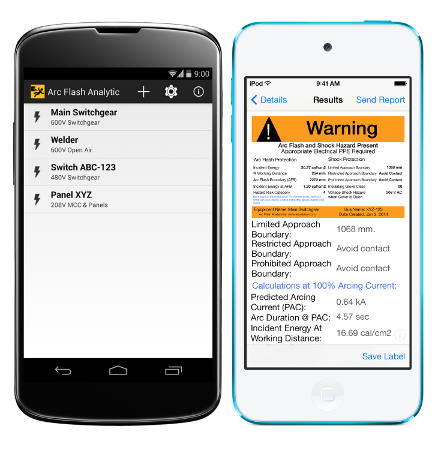
    Arc Flash Mobile

    # # #


    Friday, July 28, 2017

    ELECTRICAL SERVICES AND ARC FLASH TRAINING

    Electrical safety training, including arc flash training and shock hazard training, is not an option; it’s required by law, and recommended by industry standards. But it’s also the foundation of electrical safety, which protects your workers and your business. It’s an investment that will pay off.
    http://arcadvisor.com/faq/electrical-safety-arc-flash-training

    Wednesday, June 7, 2017

    The Elementary Safety Book for Children

    ARCAD is proud to sponsor The Elementary Safety Book for Children published by Maple Leaf Communications Inc. This free book is brought to children by businesses in local community. Do you know all the safety rules? An extensive team of animal experts show you how to play and stay safe both at home and when outside. Everything is more fun when you play safely!

    Sunday, June 4, 2017

    What's New? What's Changed? 2018 NFPA 70E Update

    The 2018 Edition of NFPA 70E is quickly approaching. Here is a link to an article by Jim Phillips / Brainfiller.com that was recently published in the May Edition of Electrical Contractor Magazine. As usual, some changes were minor, others were quite major. There is also quite a bit of reorganization.

    2018 NFPA 70E Changes Article

    PS: There are changes to the definition of arc flash boundary in the upcoming NFPA 70E Standard for Electrical Safety in the Workplace. Specifically, the revised definition of arc flash boundary no longer uses the term "second degree burn" but instead "at which incident energy equals 1.2 cal/cm2.", and the revised informational note references the Stoll skin burn injury model.

    NFPA 70E year 2004 assumed that the incident energy requirement increases below one second. A quote from NFPA 70E year 2004 "For situations where fault-clearing time is 0.1 second (or faster), the Flash Protection Boundary is the distance at which the incident energy level equals 6.24 J/cm^2 (1.5 cal/cm^2)." This reference was removed in NFPA 70E year 2012 edition. NFPA 70E year 2012 stated that "a second degree burn is possible by an exposure of unprotected skin to an electric arc flash above the incident energy level of 1.2 cal/cm2 ( 5.0 J/cm2 )" and assumed 1.2 cal/cm2 as a threshold incident energy level for a second degree burn for systems 50 Volts and greater. NFPA 70E year 2015 explicitly prohibited using incident energy and PPE category together. The NFPA Handbook from 2015 showed a sample label with fields to be filled in for "available incident energy" and "level of PPE" while just half a page earlier states that "available incident energy" cannot be included with the "PPE category" in table 130.7(c)15(A)(b).

    The revised definition of arc flash boundary in NFPA 70E year 2018 is even more misleading. It also contradicts the accompanying revised informational note referencing the Stoll skin burn injury model. A quote from A.Stoll "Heat Transfer in Biotechnology" summarizes the issue of using a critical thermal load approach in determining arc flash boundary. The quote reads:

    "Serious misconceptions have crept into this field of research through adoption of rule-of-thumb terminology which has lost its identity as such and become accepted as fact. A glaring example of this process is the “critical thermal load.” This quantity is defined as the total energy delivered in any given exposure required to produce some given endpoint such as a blister. Mathematically it is the product of the flux and exposure time for a shaped pulse. Implicit in this treatment is the assumption that thermal injury is a function of dosage as in ionizing radiation, so that the process obeys the "law of reciprocity," i.e., that equal injury is produced by equal doses. On the contrary, a very large amount of energy delivered over a greatly extended time produces no injury at all while the same "dose" delivered instantaneously may totally destroy the skin. Conversely, measurements of doses which produce the same damage over even a narrow range of intensities of radiation show that the "law of reciprocity" fails, for the doses are not equal."

    Here is what ASTM F1959/F1959M Standard Test Method for Determining the Arc Rating of Materials for Clothing says about skin burn injury determination:

    "12.1.4 Predicted Second-Degree Skin Burn Injury Determination (Stoll Curve Comparison) — The time dependent averaged heat energy response for each panel [..] is compared to the Stoll Curve empirical human predicted second-degree skin burn injury model:

    Stoll Response, cal/cm2 = 1.1991 * ti^0.2901

    where ti is the time value in seconds of the heat energy determination and elapsed time since the initiation of the arc exposure. A second-degree skin burn injury is predicted if either panel sensor heat energy response exceeds the Stoll Response value (at time ti)."

    Incident energy alone has no impact on thermal damage and blast pressure. One can expose himself to any arbitrary incident energy and suffer no damage as long as the energy is delivered at slow enough rate. On the other hand, an exposure to only a fraction of 1.2 cal/cm2 may result in incurable burn provided that the energy has been delivered fast enough. Read Evaluation of onset to second degree burn energy in arc flash hazard analysis for more information. The issue of using incident energy as a measure of damage alone and without regard to the rate of the energy release has been raised to NFPA 70E committee before year 2015 edition was published but unfortunately it was never appropriately addressed by the group.

    Sunday, December 18, 2016

    Recommended Guidelines for Arc Flash Labeling

    Whenever an arc-flash study is done or revised and new arc flash warning labels must be considered, it is a good idea to define exactly what information belongs on each label before starting to print anything. It is also a good idea to define how and where these labels will be applied before anyone peels the back off of the first adhesive label and sticks it onto anything. It is a very good idea to put those definitions into writing so that everyone who assists or who comes along later, has something to help them understand the original intent. This is particularly important as a means of trying to promote consistency and to avoid creating unnecessary confusion when an arc flash analysis study is spread out over extended period of time. A guideline document such as the one published here serves that purpose. The guideline describes how electrical equipment should be labeled, namely how many labels should be applied and in which locations, after appropriate data collection, modeling, short-circuit analysis and arc-flash study activities have been completed. The intent here is not to limit the number of labels applied but rather to insure that at least the required minimum number of labels are in place. This document also addressed the question of how to label devices that were subject to protection under a selectable maintenance settings scheme. This application involved two labels as shown in Figure 6.

    The arc-flash labels discussed herein are required by the NEC in article 110.16 and by NFPA 70E in Section 130.7 (E)(1). There are two basic types of arc flash labels that should be used. They are a generic label - one that does not include specific calculated data but which identifies the existence of the hazard and refers the reader to the site 70E policy, and a specific label - one that includes calculated data for arc-flash incident energy or hazard/risk category and identifies specific required PPE. Figure 1 shows one of each type of label, with the generic type being the upper label. This guideline identifies what type of equipment we should be labeling and how to label that equipment. If a piece of equipment is identified by company guidelines as within the scope of equipment for which we should be calculating arc-flash exposure, then the label should be a specific label. Otherwise, the label will be a generic label and will refer to the overall site 70E policy. Wherever specific labels are applied, they shall describe all of the requisite PPE.

    generic arc flash label
    Figure 1A. An example of generic arc flash warning label.

    arc flash warning label sample
    Figure 1B. An example of specific arc flash warning label.

    Many facilities have been through short-circuit and arc-flash studies conducted under previous versions of the NFPA 70E regulation. In such cases, it is possible that the labels already in place in the field reflect older hazard levels and types of PPE for some of the labeled equipment and are no longer correct for the current version of NFPA 70E. It is permissible to hand-modify the existing labels if the changes are somewhat minor, but it is often confusing to do that. The preferred approach is to relabel the equipment. However, since the current version of the regulation requires review and update on a five-year cycle, it is recommended that the labels simply be corrected during the course of the next overall update.

    The generic label is a Brady product, while the specific label is a product printed as output from Arc Flash Analytic software program. Both of these labels use the ANSI Z535.4 "warning" format and an orange banner. The "danger" format with a red banner, described in the same ANSI standard, is equally acceptable.

    Read more at http://arcadvisor.com/faq/arc-flash-labeling-guidelines

    Wednesday, December 7, 2016

    Guide To Arc Flash Apps. Simple solutions for fast and accurate results.

    Arc flash applications are increasing in popularity among engineers and electricians when examining hazards presented by an arc flash. Professionals search for accessible tools to help reduce dangers associated with arc flash as well as to assist in selecting adequate personal protective equipment (PPE). Mobile apps for arc flash analysis can be useful for assessing the hazards before working on energized equipment. 

    Contrary to many simple and complex computer programs used for power system and arc flash hazard analysis, only a handful of arc flash apps are available for purchase. Each app, available in either the Apple Store (iPhone) or Google Play (Android-operated devices), vary in level of complexity and range of operations. 

    Q: What are some specific benefits to workers using arc flash apps on their mobile device?

    Qualified workers use mobile apps for data collection, field analysis of electrical equipment and evaluation of arc flash dangers when access to complex power system analysis computer software is limited or not available. Electrical and safety professionals can now find ways to minimize arc flash hazards using handheld gadgets while in the field by trying different protection device settings and by simulating various fault scenarios. 

    The apps help in meeting the requirements of CSA Z462 "Workplace Electrical Safety" and NFPA 70E: "Standard for Electrical Safety in the Workplace" published respectively by the Canadian Standards Association and the National Fire Protection Association. Arc flash mobile apps support calculations and functions for typical distribution systems that use fuses and circuit breaker protection devices. They provide for real-time display of incident energy and arc flash boundary results


    Monday, November 21, 2016

    Arcad Inc. guarantees the lowest prices

    We will match the advertised price of any print job from any other printer. Here are a few things you should know in order for our price matching to apply:
    • All specs for the order must be the same.
    • Price match must be inclusive of freight, shipping, and delivery if applicable.
    • We’ll need to know the URL for the competitor’s website, for verification purposes.
    • We reserve the right to decline any job that doesn’t fit within our business model.
    • We will price match up to 7 days as long as accurate proof is provided (invoice, receipt etc.)

    How do you receive the matching price?

    When you find another printing company that offers the same products or print service for a lower price, contact us. A friendly customer service agent will take your job specs and competing information. We’ll override the price by up to 10% provided that the price match guarantee applies.

    What if I find the lower price after I’ve placed my order?

    If you find a lower price that meets all of the criteria to qualify for our price match guarantee within 7 days of placing your order with Arcad Inc., please give us a call or send us an email with all your information. We will confirm all order specs and options are the same, then credit you the difference.

    Thursday, November 10, 2016

    The results of arc flash assessment

    The arc flash analysis should result in calculated incident energy, incident energy at arc flash boundary (AFB) and AFB at each piece of electrical equipment under study. The results of the arc flash hazard analysis would typically be shown in form of the arc flash hazard table. The table shows the parameters upon which the arc flash hazard is based. Read more at http://arcadvisor.com/faq/arc-flash-assessment-results

    Wednesday, November 9, 2016

    Protective Device Coordination Study

    Properly engineered systems will allow only the protective device nearest the fault to open, leaving the remainder of the system undisturbed and preserving continuity of service. A protective device coordination study is required to properly select and set the power systems protective devices to achieve this goal. This is accomplished by performing a time current evaluation among the protective devices.
    Coordination is generally a compromise between the mutually desirable but somewhat inconsistent goals of maximum protection and maximum service continuity. With the use of molded circuit breakers it is usually impossible to coordinate the system in the instantaneous region due to the overlap of curves unless a zone interlock is utilized. For this and other reasons, such as established system design, many combinations of device settings may be classified as acceptable. The settings suggested in the arc flash hazard calculation study result from an exercise of judgment as to the best balance between competing objectives. Read more at http://arcadvisor.com/faq/protective-device-coordination-study

    Short Circuit Analysis Report

    A short circuit study determines the short circuit currents available at various points in the system. This information is necessary to evaluate the equipment being utilized in the system, to set the protective devices and to ensure that its ratings comply with the NEC 110.9, Interrupting Rating, and 110.10, Circuit Impedance and Other Characteristics. The available short circuit fault current is the key component in calculating incident energy and arc flash boundary. Hence, the calculated short circuit currents and a protective device evaluation should be included in the short circuit section of the arc flash hazard calculation study report. Read more at http://arcadvisor.com/faq/short-circuit-analysis-report

    Tuesday, November 1, 2016

    Lets talk

    ARCAD is proud to offer its clients real-time product & service support by chatting with a technical expert assistant live, from the convenience of your computer. Just look for the Let's Talk popup on the bottom right of any page of the company website located at http://arcadvisor.com

    http://arcadvisor.com
     

    Standard and custom label printing services

    ARCAD INC. offers many options of custom printed arc flash labels. Our Facebook album features most popular label designs we've made and printed for our valued customers. Browse the gallery, pick the design you like and let us print labels for you. Can’t find what you need? It is easy to design and order custom stickers and labels. We will manufacture to your specifications at our manufacturing facility.
    Our vinyl labels are 100% waterproof and are suitable for use on equipment that will be subjected to wet or humid environments. We use UV resistant paints that withstand the heavy wear and tear ordinarily inflicted by the Sun. We offer 5 years warranty for laminated vinyl labels. Check http://arcadvisor.com/faq/arcflash-label-printing for more information about standard and custom label printing services we offer.

    Thursday, January 21, 2016

    Issue #32 - Developments in arc flash modeling and labeling

    These are some of the latest topics on various aspects of arc flash you may find interesting:

    DC ARC FLASH MODELING AND ITS IMPLEMENTATION IN DCAFA V3.0 SOFTWARE PROGRAM

    Except for two technical papers referenced in the annex of NFPA 70E, DC arc flash equations and calculation methods are not yet part of any standard. As research on DC arc flash and DC source modeling continues, DC arc flash calculation methods will likely become part of a standard someday.
    http://arcadvisor.com/faq/dc-arc-flash-boundary-modeling

    SINGLE PHASE ARC FLASH ANALYSIS

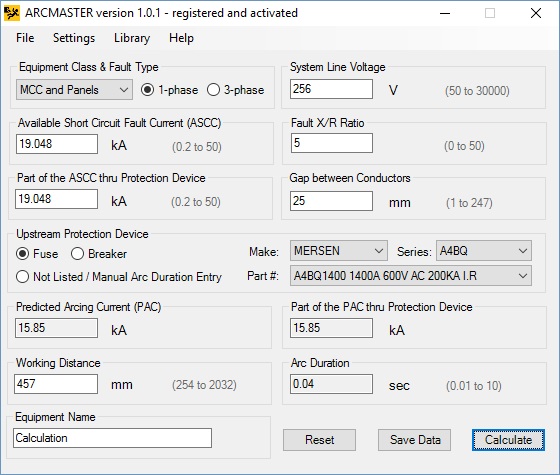
    There are very few software packages in the industry that can model single-phase arcs for the purpose of determining incident energy in substations. ARCAD has recently released new ArcMaster software program. The program performs comprehensive study by taking into account system voltage, available fault current and the fault power factor, equipment type, working distance and protective device time-current characteristics. The new software program is applicable for single- and three-phase systems with voltages from 50 to 30,000V AC, short circuit fault currents from 200A to 50kA, the fault X/R ratios from 0 to 50, conductor gaps from 1 mm. up to the maximum value where the arc can likely be sustained under the specified system voltage, available short circuit fault current and power factor expressed in terms of the fault X/R ratio.
    http://arcadvisor.com/faq/single-phase-arc

    ELIMINATION OF HRC "0"


    Category 0 was removed from new NFPA 70E PPE tables because the new PPE table only specifies work within the arc flash boundary. HRC 0 would mean the worker was outside the arc flash boundary and did not need arc-rated PPE or clothing. According to note (14) on page 7, "Hazard/risk category 0 has been removed from Table 130.7(C)(16)… Hazard/risk category 0 was deleted because the new PPE table only specifies work within the arc flash boundary. If there is no arc flash hazard, then no arc flash PPE is required and it is therefore not necessary on a table devoted to PPE."
    http://arcadvisor.com/faq/nfpa-70e-category-0-removed

    CUSTOM LABEL GENERATION AND PRINTING SERVICES

    ARCAD INC. offers many options of custom printed arc flash labels. Our vinyl labels are 100% waterproof, are suitable for use on equipment that will be subjected to wet or humid environments and come with up to five (5) years warrantly. We use UV resistant paints that withstand the heavy wear and tear ordinarily inflicted by the Sun. As you shop around for the best arc flash labels, make sure you request samples. When you compare our arc flash labels to the major competitors in the market, you will see and feel the difference. While some companies offer you paper-thin easily torn arc flash labels, we offer you 4mil thick vinyl labels with superior print and durability.
    http://arcadvisor.com/faq/customized-label-printing

    HOW TO PROPERLY APPLY AND REMOVE VINYL LABELS


    When installing vinyl, it is important that you apply the product to an adequate surface, one to which it will readily adhere. The good news is vinyl will stick to many surfaces. In determining whether your intended surface is adequate, keep in mind that, as a general rule of thumb, vinyl will stick to almost any surface that is clean and either smooth or nonporous. To demonstrate the necessary surface qualities, we use glass versus brick as a quick example. Vinyl will stick very well to glass because of its smooth surface. On the other hand, due to its rough exterior, vinyl will not stick well to brick. The following lists contain a brief summary of acceptable surfaces along with some surfaces that are not.
    http://arcadvisor.com/faq/apply-vinyl-label-decals

    Monday, January 4, 2016

    Product Release - ARCMASTER V1.0


    PRESS RELEASE
    January 4, 2016
    For Immediate Release
    ARCAD INC.

    ArcMaster version 1  

    The new software program for single- and three-phase arc flash hazard analysis & labeling is now available. 
    TORONTO, ON - ARCAD INC. announces the release of ARCMASTER V1.0 software program for Windows operating systems.

    Download ARCMASTER V1.0

    ARCMASTER V1.0 performs comprehensive study by taking into account system voltage, available fault current and the fault power factor, equipment type, working distance and protective device time-current characteristics. The new software program is applicable for single- and three-phase systems with voltages from 50 to 30,000V AC, short circuit fault currents from 200A to 50kA, the fault X/R ratios from 0 to 50, conductor gaps from 1 mm. up to the maximum value where the arc can likely be sustained under the specified system voltage, available short circuit fault current and power factor expressed in terms of the fault X/R ratio. The program has also been code signed by use of a cryptographic hash confirming the software owner and warranting that the code has not been altered or corrupted since it was signed.

    More information about ARCMASTER V1.0 software is available at http://arcadvisor.com/arcmaster-software


    ARCAD INC. located in Toronto, Canada helps facilities create safer working environments for individuals who service electrical systems by providing on-line and stand-alone software resources for short circuit, arc flash hazard analysis and labeling. Visit us at http://arcadvisor.com

    More by ARCAD INC.


    Arc Flash Mobile

     
    # # #


    Wednesday, December 9, 2015

    Product Release - DC Arc Flash Analytic version 3.0


    PRESS RELEASE
    December 9, 2015
    For Immediate Release
    Contact: Michael Furtak, C.E.T.
    ARCAD INC.

    DC Arc Flash Analytic version 3  

    The new software program for DC arc flash hazard analysis & labeling is now available. 
    TORONTO, ON - ARCAD INC. announces the release of DC Arc Flash Analytic version 3.0 (DCAFA V3.0) software program for Windows operating systems.

    Download DCAFA V3.0 for FREE


    DCAFA V3.0 performs comprehensive study by taking into account system voltage, available fault current, equipment configuration, working distance and protective device time-current characteristics adjusted for the circuit time constant. DCAFA V3.0 is applicable for systems with voltages from 180 to 15,000V DC, short circuit fault currents from 400A to 50kA, circuit time constants from 0 to 50 milliseconds, conductor gaps from 0.1 to 6 inches. The program has also been code signed by use of a cryptographic hash confirming the software owner and warranting that the code has not been altered or corrupted since it was signed.

    More information about the DCAFA V3.0 software is available at http://arcadvisor.com/dc-arc-flash-software
     
    ARCAD INC. located in Toronto, Canada helps facilities create safer working environments for individuals who service electrical systems by providing on-line and stand-alone software resources for short circuit, arc flash hazard analysis and labeling. Visit us at http://arcadvisor.com

    More by ARCAD INC.


    Arc Flash Mobile

     
    # # #


    Thursday, October 15, 2015

    Issue #31 - Developments in Fault Current, Arc Flash Calculations and Labeling

    Here at ARCAD INC, we are deeply thankful for your confidence and loyalty and extend to you our best wishes for a happy and healthy Canadian Thanksgiving Day. Peace, Joy and Love to You. We would also like to update you on the important developments and a SPECIAL offer we have for you.

    ARCAD's Short Circuit Analytic version 1.0 (SCA V1.0) program voltage range has been extended down to 115V and up to 220,000V. Also, new voltage rating combo box has been added to cable data entry screen and maximum transformer KVA rating was increased to 20,000KVA. More information about the SCA V1.0 software for short circuit fault current calculations is available at http://arcadvisor.com/short-circuit-software

    ARCAD's Arc Flash Analytic version 5.0 (AFA V5.0) arc flash analysis and labeling software has been updated to fully conform with new NFPA 70E year 2015 requirements for equipment labeling. The labels created using the modernized AFA V5.0 program are now containing all the information required by the new standard, namely:

    * Nominal system voltage
    * Arc flash boundary
    * Available incident energy and the corresponding working distance
    * Site-specific level of personal protective equipment (PPE)

    More information about the AFA V5.0 software is available at http://arcadvisor.com/arc-flash-software

    Both the AFA V5.0 and the SCA V1.0 software have also been code signed by use of a cryptographic hash confirming the software owner and warranting that the code has not been altered or corrupted since it was signed.

    Now comes the special offer. Purchase $350+ merchandise value before taxes on our new online store at http://store.arcadvisor.com and receive FREE brand new Type 1 Surge Protection Device (SPD) priced above $200 on the market. The "TYPE 1" are permanently connected SPDs installed between the secondary service transformer and the line side of the service equipment overcurrent device as well as the load side, including watt-hour meter socket enclosures. The device characteristics are:

    * Manufacturer Name & Part Number: Mersen STXR220V3Y50NDP
    * System Description: 3 Pole Wye + N-G Mode
    * Voltage, V AC: 220/380
    * Max Discharge Current: 50KA
    * Nominal Discharge Current: 20KA
    * Short Circuit Current Rating: 200 kA
    * Voltage Protection Rating: 2000V L-L, 1200V L-N, 1000V N-G, 1800V L-G
    * Maximum Continuous Operating Voltage: 320V L-N
    * Mounting: Din Rail / Panel / Bracket
    * Operating Temp Range (Min/Max): -40 to +60C
    * Body Material & Enclosure Rating: Polycarbonate NEMA 4X
    * Standards: Type 1, UL 1449 Third Edition File VZCA. E210793 IEC 61643 CE ANSI/IEEE C62.41
    * Applications: AC Distribution, Power Supplies, Drive Protection Fire, Alarms Control Panels, Telecommunications, Residential, IT / Data centers
    * Pre-wired with 3 ft. (1m) of #10 AWG conductor; Standard NEMA 4X polycarbonate enclosure; Tri-mount installation kit included (pipe nipple, bracket, DIN-rail)
    * Other Included Features: Dry contacts, audible alarm and diagnostics powered line to line
    * Market Price: $200+

    Check http://arcadvisor.com/files/mersen-pdf/Surge-Protection-Trap-Type-1-XR-Series-SPD.pdf for the product spec sheet. Use "FALL 2015 SPECIAL" in the About Your Order comments box  during checkout.

    Wednesday, September 9, 2015

    Issue #30 - Fancy product design and custom label printing

    We hope you had a great summer and fully used the chance to relax, spend time with your loved ones, and look forward to fall and winter ahead. Remember there is another summer next year, and you can work to make that one even bigger, better, and more fun than the last.

    Here at ARCAD INC., we've been working hard during the summer time to offer you more products and services now in the Fall. We would like to express to you our sincere appreciation for your loyalty and take this opportunity to update you on new ARCAD INC. products and services.

    FANCY LABEL DESIGN PLUGIN

    Select the header that you want on the top of your label, or use your own header. Enter your text into the text areas below. Use a short phrase to describe the hazard and ideally, how to avoid the hazard. For example, "Moving Belts". You may like to complete both primary and secondary warning messages. Generally, use the primary message to indicate the necessary action to take so that you avoid the hazard (for example, "Keep Hands Free"). If possible, then indicate the nature of the hazard (for example, "Machinery may start at any time."). Use the secondary message to indicate the potential consequences if you do not avoid the hazard (for example, "You could be caught and be seriously injured.") and a telephone number to call in an emergency (for example, "Call x2015 for permission to work on this machinery."). You can save your designs, load previously saved design, download your customized label sign in electronic image or .pdf format and print it at no charge!

    http://store.arcadvisor.com/index.php?route=product/category&path=61_70

    CUSTOMIZED LABEL DESIGN AND GENERATION

    ARCAD INC. offers many options of custom printed arc flash labels. Send us your data and we will create a free sample label accommodating your special requirements and send it to you for your approval along with job quotations. ARCAD is also producing luminescent signs glowing in the dark and magnetic signs that can be be removed or shared among equipment and vehicles. Contact us for more information.

    http://arcadvisor.com/faq/customized-label-printing

    5-YEAR LAMINATED VINYL WARRANTY

    ARCAD INC. supplies are tested for durability under various conditions, including UV exposure, moisture, heating and cooling and chemical exposures. ARCAD INC. warranties labels made from its laminated vinyl supplies for a period of five (5) years. Non-laminated labels come with three (3) years warranty. It is important to note that in normal circumstances (moderate exposure to Sun shine, moderate temperature fluctuation etc.) ARCAD's labels will last for decades. Within the warranty period and after proper application, ARCAD INC. will replace labels which become unreadable or fail to maintain adhesion with the labeled surface. In such instance, ARCAD INC. will provide a one-time replacement labels to you.

    SOCIAL MEDIA

    Did you know that we are now on Google+ and Facebook? We are updating regularly so we invite you to take a look and stay up-to-date by liking or following our social media pages. If you choose to "Friend" or "Like" us, you will know when we release new product or service or post special deals and announcements.

    Google +
    https://plus.google.com/+Arcadvisor/posts

    Facebook
    https://www.facebook.com/arcadinc

    Tuesday, August 18, 2015

    Issue #29 - Worplace, fire safety, facility signs and posters.

    We are pleased to introduce a new ARCAD INC. safety supplies store online at http://store.arcadvisor.com. ARCAD is now providing high-quality, dependable products you can trust to keep employees and work sites safe. We offer standard materials and sizes, and an easy to use online shopping experience. Search by keyword, part number or category to find exactly what you need to help keep your workers safe and your workplace compliant with safety regulations. Shop our store, or simply contact us at (647) 693-7715 or sales@arcadvisor.com. We are happy helping you meeting your needs.

    All safety signs come in three size options (6 x 4, 9 x 6 and 12 x 8 inches) and are UV, water, and smear resistant. All are printed with UV-stable ink and are suitable for indoor or outdoor use at service temperatures from -40 to +180 F. Substrate choices are:

        - Flexible vinyl 4mil self-adhesive "peel & stick" label stock
        - Semi-flexible laminated vinyl self-adhesive label
        - Rigid aluminum 3mm thick composite panel

    Can’t find what you need? It is easy to design and order custom stickers and labels. We will manufacture to your specifications at our manufacturing facility. 

    ARCAD INC. is also offering many options of custom printed arc flash labels. Send us your data in Excel spreadsheet or plain text format. We will create a free sample label accommodating your special requirements and send it to you for your approval along with job quotation.

    Monday, July 27, 2015

    Issue #28 - ARCAD website redesigned and revamped

    After much hard work, we are pleased to introduce a completely redesigned ARCAD website at www.arcadvisor.com. Please take a few moments to navigate through the updated website. We hope you enjoy the new design and you'll find time to look through the many pages of information waiting for you behind the new home page. Please feel free to let us know about any suggestions you might have or additional material you would like to see on the website.

    We have also recently released new Short Circuit Analytic (SCA) mobile app. The app takes into consideration all of the key electrical parameters of power distribution system including power supply, cables, transformers, motors, generators and performs available short circuit 3-phase and phase to phase fault current calculations in three-phase radial electric power systems. Visit the SCA mobile product page online at http://www.arcadvisor.com/short-circuit-software for more information.

    Did you know that most fabrics recommended for protection against electric arc fires will burn vigorously when exposed to a sufficiently large and sustained exposure fire? NFPA 70E allows flammable clothing with a fabric weight at least 4.5 oz/yd2 to be worn when working on tasks stated low risk. Stating a task as low risk and allowing the use of apparel fabrics may lead to severe injuries and fatalities from clothing ignitions in arc flash incidents. A method predicting the behavior of the fabrics during convective and radiant heating has been developed, and an article describing the method was recently published in the International Association of Electrical Inspectors (IAEI) magazine. Please follow the link at http://www.arcadvisor.com/faq/ignition-melting-characteristics-fabrics-textiles for more information.